Kentucky Horse Farms: Property Tax Relief and Sales Tax Exemptions
August 13, 2026
August 13, 2026
A buyer considering a small equestrian property might ask a simple question: would owning ten acres and two horses allow purchases of hay, fencing, and barn supplies without paying Kentucky sales tax? The answer might be surprising. The land could qualify for a property tax break. The horses would not qualify the buyer for the sales tax exemption available to qualifying agricultural operations. Same farm, same county, two completely different answers, because Kentucky runs two separate agricultural exemption programs under two separate statutes, and only one of them was written with horses in mind.
The "agricultural exemption" is not a single benefit that kicks in once you clear ten acres, a threshold the Franklin County PVA describes for its agricultural exemption. If you are looking at property in Jefferson, Oldham, or Shelby County with horses in the plan, understanding the split between these two programs matters more than the acreage number on the listing sheet.
The first program is a property tax break. Kentucky's counties assess farmland under KRS 132.010, which defines agricultural land as any tract of at least ten contiguous acres used for the production of livestock, livestock products, poultry, or crops including timber. Land that qualifies gets assessed at its agricultural use value rather than its fair cash value, which typically means a meaningfully lower tax bill on the land itself. Every county Property Valuation Administrator, including Jefferson County's PVA, administers this locally, and it applies to the land, not the house on it. A farm residence occupied by the owner still gets assessed at fair cash value even when the surrounding acreage qualifies for the ag rate.
The second program has nothing to do with property tax. It is a sales and use tax exemption, run through the state Department of Revenue under KRS 139.480 and 139.481, that lets qualifying farmers buy feed, farm chemicals, machinery, and on-farm facilities without paying sales tax at the register. To use it, a farmer applies for an Agriculture Exemption Number and presents it at the point of sale. This is the program that allows qualifying agricultural operations to avoid sales tax on eligible purchases. It is also the program that, according to the Department of Revenue's own guidance, explicitly excludes horses. The agency's FAQ document states plainly that raising horses and beekeeping do not qualify for the exemption number.
Here is the comparison in plain terms:
| Property Tax Ag Assessment | Sales & Use Tax AE Number | |
|---|---|---|
| What it reduces | Annual property tax on land | Sales tax on feed, chemicals, machinery, on-farm facilities |
| Governing statute | KRS 132.010 | KRS 139.480 / 139.481 |
| Who administers it | County PVA | State Department of Revenue |
| Minimum size | 10 contiguous acres (5 for horticultural) | No acreage test, tied to farming activity |
| Horses included | Generally yes, as part of livestock production | No, explicitly excluded |
The exclusion is not an oversight. A legal review of Kentucky's equine tax rules by the law firm Dean Mead traces it to a Kentucky Court of Appeals decision that examined whether horses met the statutory definition of livestock for sales tax purposes. The court reasoned that horses are bred and raised rather than processed into food products, and since the livestock definition tied to that statute was built around consumption, horses fell outside it. A separate tax guide from Dinsmore walks through the same reasoning and notes that horse farmers, unlike cattle or hog operations, have historically paid full sales tax on the supplies that keep their operations running.
This is where the confusion compounds. In 2017, the Kentucky General Assembly passed Senate Bill 139, which amended several state statutes to formally define equine as livestock. The bill passed the Senate 38 to 0 and the House 97 to 0. But the Kentucky Farm Bureau's own coverage of the bill notes that the legislation did not touch the sales and use tax statutes at all. So as of today, a horse in Kentucky can be legally classified as livestock for animal welfare and transport purposes while remaining outside the livestock definition that governs sales tax exemptions. Two statutes, two answers, same animal.
There is one useful carve-out buried in the same tax code. Receipts from boarding and training horses within Kentucky are exempt from the use tax. So a horse farm that boards or trains for other owners can claim an exemption on those service receipts even while paying full sales tax on the feed and fencing that make the boarding possible.
A horse farm can be classified as agricultural land by the county on the same afternoon it pays full retail sales tax on a load of grain. That is not a contradiction in the paperwork. It is how the law is actually written.
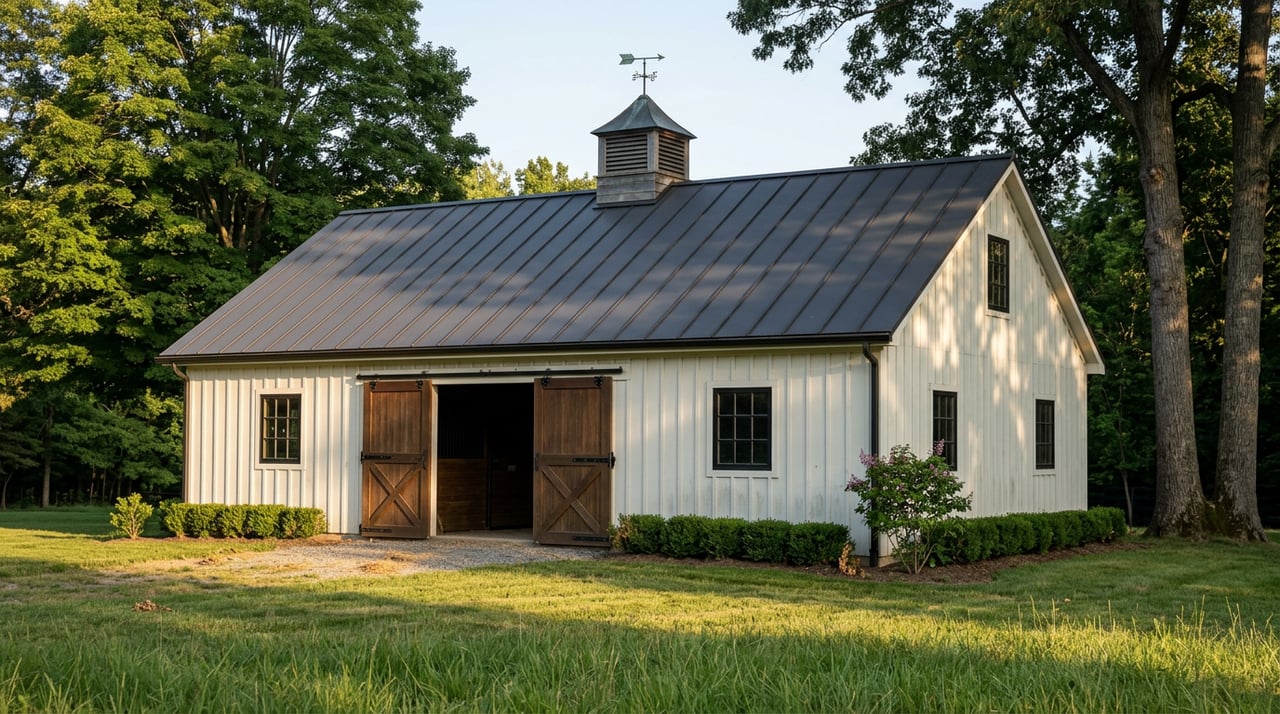
Drive out US-42 through Oldham County and you pass some of the farms this distinction is written for, the horse operations clustered around Goshen and Skylight, the L'Esprit equestrian community, and Hermitage Farm, a working thoroughbred operation that has hosted visitors including Queen Elizabeth II. Land like this often clears the ten-acre threshold easily and typically qualifies for the property tax break once an owner applies. That is real, ongoing savings on the tax bill for the land itself.
What buyers frequently do not budget for is the other side. Every bag of feed, roll of fencing wire, piece of barn equipment, and load of stall bedding gets purchased at full retail sales tax, because the AE Number that would waive it does not cover horse operations. For a working farm running dozens of horses, that adds up over a year in a way a single cattle or crop operation of comparable size would not experience. It is worth running that math before closing, not after the first year of feed bills arrives.
According to the Adair County PVA, the property tax classification does not automatically transfer with the deed. Kentucky's statute states that an agricultural application remains valid only until the property is transferred or the land use changes. That means a new owner needs to reapply with the county PVA, and the deadline to file for a given tax year is on or before March 1. Miss that window after a late-winter closing and you may be paying fair cash value on the land for a full year before the ag rate kicks in.
Because Jefferson, Oldham, and Shelby counties each run their own PVA office, the underlying statute is the same but the paperwork, inspection schedule, and staff you talk to are not. A buyer moving between counties, say from a Prospect property into Shelby County's saddlebred country, should expect to start the conversation with a new office rather than assume anything carries over.
None of this is a substitute for advice from a Kentucky tax professional or CPA who can look at your specific acreage, activity, and closing date. The statutes and case law described here are matters of public record, but how they apply to your farm is worth confirming before you write an offer, not after.
Does boarding other owners' horses count toward the agricultural exemption? Boarding and training receipts are exempt from Kentucky's use tax on their own, separate from the AE Number program. That exemption applies to the service income, not to the feed and supplies used to provide it.
If I buy a farm that already has the ag property tax classification, does it transfer to me? No. The classification stays valid only until the property changes hands or the land use changes, so a new owner needs to file a fresh application with the county PVA, generally by March 1 for that tax year.
Does this work the same way in Jefferson, Oldham, and Shelby counties? The underlying state statute is identical everywhere in Kentucky, but each county PVA handles its own applications, inspections, and deadlines, so confirm the process with whichever office covers the property you are buying.
If you are looking at equestrian property in Louisville's horse country and want a clearer picture of what a specific farm's tax situation actually looks like before you make an offer, reach out to Brooke Miller to request a consultation. Third-generation local knowledge and years of walking these farms with buyers means fewer surprises after closing, not more.
This article is general information, not legal, tax or financial advice. Consult a qualified professional about your situation.
Stay up to date on the latest real estate trends.







Work with a third-generation Louisville REALTOR® with over 16 years of experience, and enjoy a seamless, personalized real estate experience backed by integrity and dedication.