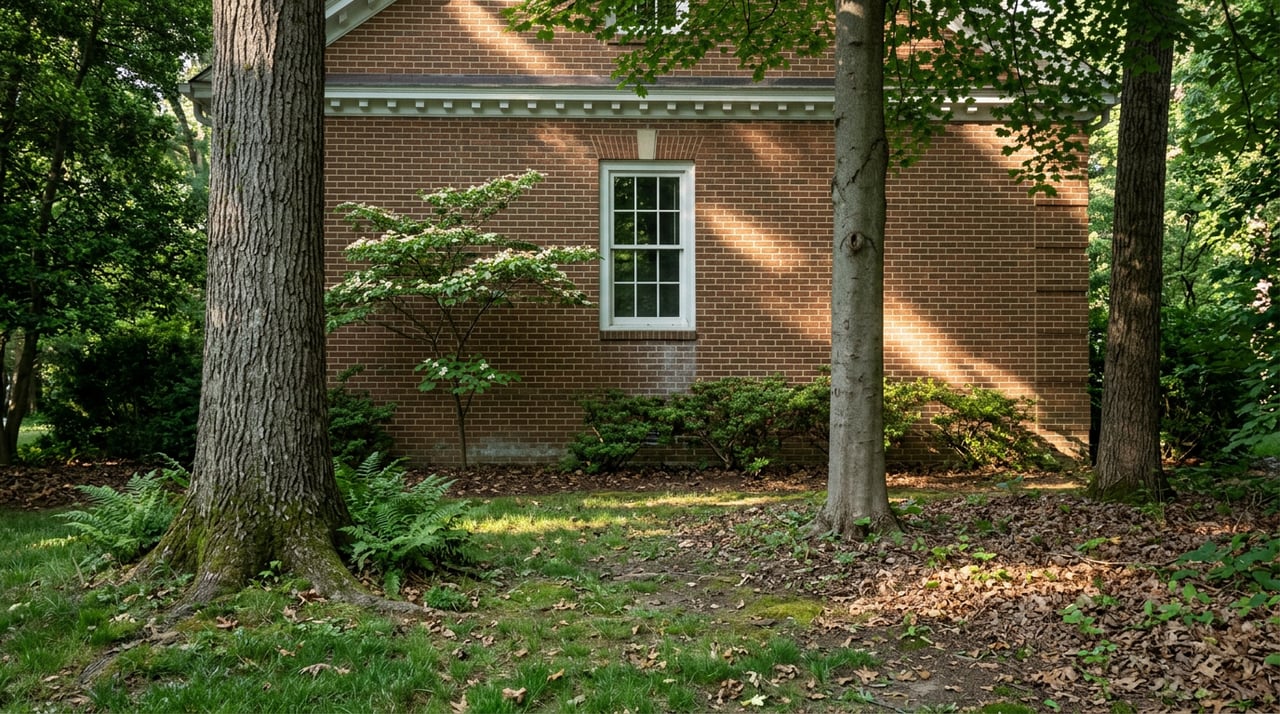
Indian Hills, Louisville in Late Summer: How the Canopy Endures
August 20, 2026
August 20, 2026
By late August, the loop trail at Caperton Swamp has usually shrunk to something closer to a series of connected puddles than a pond. Great blue herons still work the shallow edges. Painted turtles stack themselves on the last visible logs. If you walk the 0.8-mile path at the corner of Indian Hills Trail and River Road in the early morning, before the highway noise from I-71 picks up, you can watch the whole ecosystem contract into its driest, most honest version of itself. The 31 acres here have looked roughly like this since Louisville Metro Parks brought the core acreage into public hands in 1978, with additional parcels folded in through the 1980s thanks to the conservation group River Fields.
That sense of permanence is the thing most people who live in Indian Hills would tell you defines the neighborhood. The trees are old. The roads curve the way they've always curved. The Country Club has been sitting at the center of the map since the 1920s. But permanence, at least the version of it that Indian Hills residents actually walk through every day, is not something the neighborhood inherited and left alone. It's something a handful of committees actively renew every single year, on a schedule that runs through the same fall calendar as the neighborhood's biggest party.
Start with the trees, because they're the detail every visitor comments on and almost no resident can explain the mechanics of. Indian Hills didn't get its current canopy by accident or by zoning restriction alone. Since 2017, the city has run a cost-share Tree Program with participating residents, and more than 230 canopy trees have gone into the ground through it.
The math for 2025 looked like this: total cost per tree, $575. The homeowner covers half, $287.50. The city covers the other half. One tree per household, and it has to go in the front or side yard, not tucked away in back where nobody driving down the street will ever benefit from it. Applications go in through the city's website, and every application gets entered into a drawing held at the annual Oktoberfest, the same October event where residents show up for games, barbecue and live music. You don't win a specific tree at the drawing. You win the chance to plant one, on the city's dime for half its cost.
That detail matters more than it looks like it should. It means the leafy, established feel that makes Indian Hills read as timeless from a car window is actually the compounding result of nine annual application cycles, each one decided in part by a raffle at a neighborhood festival most people attend for the funnel cake. The canopy isn't standing still. It's being replenished on a schedule, funded jointly, and voted on in the same room where residents debate everything else.
That room, for what it's worth, is the Louisville Boat Club at 4200 River Road, where the City Council meets at 6 p.m. on the third Thursday of every month. The tree program, along with the rest of the city's budget and infrastructure decisions, gets worked out there, not at some distant metro office. If you've never sat in on one of those meetings, the tree line on your street was decided by people who live two or three blocks from you.
Caperton Swamp predates the tree program by decades, but it shares the same quality of being more curated than it first appears. The land takes its name from the Caperton estate, whose entrance arch once stood on the property. In 1990, concerned about the structure's condition, the city relocated the Caperton Arch to Mockingbird Gardens on Brownsboro Road, where it stands now, a mile or so from the swamp that still carries the family name but none of the original architecture.
What's left is a nature preserve where hunting isn't allowed and construction can't happen under the terms of the deed restrictions that came with the land. The pond habitat draws birders after turtles and blue herons, and in wetter seasons you'll see the occasional beaver working the timber at the pond's edge. In the driest stretch of late summer, the swamp does what wetlands do: it recedes, concentrates, and becomes a smaller, denser version of the same place. Trail-goers should expect soft ground and some mud even after the water visibly drops, since the underlying timber stays flooded longer than the surface suggests.
If you want to extend the walk into an actual run, the neighborhood's winding, hilly streets are worth the trip on their own. The best stretch runs east of the Country Club as far as I-264 and north of Brownsboro Road, though most of those streets don't have sidewalks, so it's worth sticking to the quieter residential side streets rather than the busier main roads. For a longer route, the Ohio River Trail picks up just north of the Country Club and connects out from there.
Here's where the contrast gets sharp. While the interior of Indian Hills renews itself slowly and deliberately, one tree application cycle at a time, the commercial edge it borders is turning over faster than it has in years.
According to WDRB, the address at 4864 Brownsboro Road is about to change hands again. It spent years as Anoosh Bistro before becoming Hen House Café & Provisions, and now it's being taken over by Wasabi, a restaurant group based in Elizabethtown bringing sushi, hibachi bento boxes, and a menu that also stretches into Thai, Vietnamese and Korean dishes, with prices reported to run from about $15 to $70. That's three concepts in one storefront in a stretch of road that Indian Hills residents drive down constantly for everything else that corridor holds: Gasthaus, the German restaurant known locally for sauerbraten and spaetzle, Brownsboro Hardware a few doors down, Noosh Nosh over in Brownsboro Center serving brunch and brick-oven pizza to the East End, Crescent Hill and St. Matthews crowd alike, and Mesh a short drive further down at 3608 Brownsboro Road.
Layer onto that the $130 million improvement project the Kentucky Transportation Cabinet has underway at the I-264 and US 42 (Brownsboro Road) interchange, with completion expected in the fall of 2027. Residents have been encouraged to sign up directly for KYTC's traffic alerts, since the weekly impacts change as construction phases shift. For a neighborhood whose interior prides itself on curving, quiet, unhurried streets, the border it depends on for dinner, hardware, and a quick errand is in the middle of a genuinely active stretch of change.
None of this makes Indian Hills less stable. It makes the stability more interesting, because it isn't passive. The trees that define the streetscape are the product of an annual application, a cost split, and a raffle at Oktoberfest, not an accident of old growth. The swamp that reads as untouched wilderness is a legally restricted preserve named for an arch that isn't even there anymore, expanded piece by piece through the 1980s by a conservation group working parcel by parcel. And the corridor everyone assumes is a fixed backdrop to daily errands, the one with the German restaurant and the hardware store, is turning over storefronts and rerouting traffic in ways that will look different by the time that interchange project wraps.
The unchanging feel of Indian Hills is manufactured, in the best sense of that word. It gets decided at the Boat Club on the third Thursday of most months, funded half by residents and half by the city, and renewed one canopy tree at a time.
If you're weighing a renovation, a tree application, or just curious what a specific stretch of Indian Hills is actually worth in today's market, Brooke Miller has spent years tracking exactly this kind of detail, the kind that tells you what a neighborhood actually values instead of what it looks like from the road. Reach out for a free home valuation and consultation whenever you're ready to talk through what's next.
Stay up to date on the latest real estate trends.

Work with a third-generation Louisville REALTOR® with over 16 years of experience, and enjoy a seamless, personalized real estate experience backed by integrity and dedication.